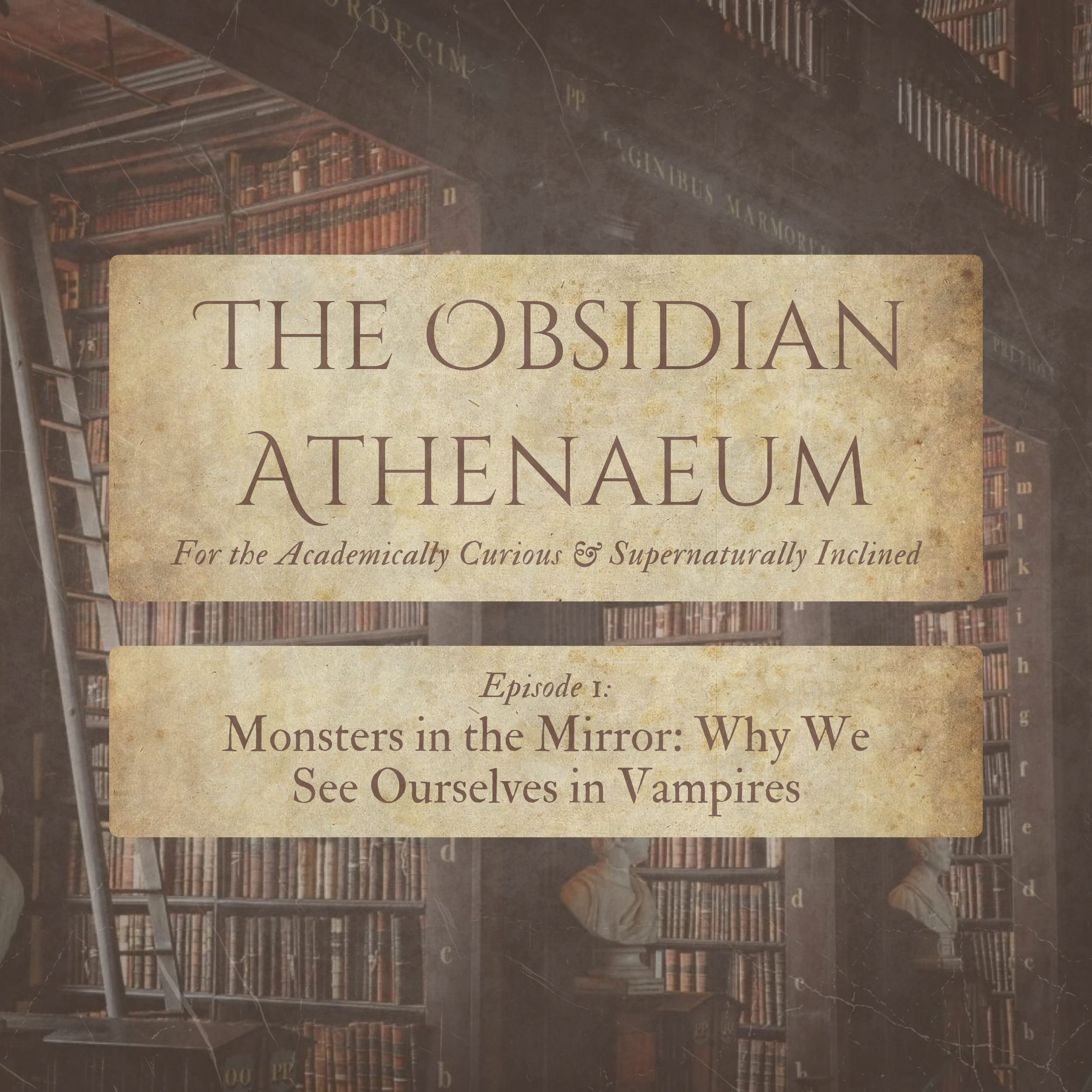
For the Athenaeum’s debut episode…
Grab your favourite red wine, light some candles, and maybe hang a string of garlic at the door. Host Fubuki welcomes their two good friends Dr. Alex Vermillion and Cannon Atkinson to discuss everyone’s favourite dark, dreamy, and dangerous creature: the vampire. The trio sinks their teeth into Stoker’s Dracula, Rice’s Vampire Chronicles, Coogler’s Sinners, what it means to see ourselves in the vampire, and what the future of vampirism could hold given society’s ever-shifting fears and anxieties.
Listen to the full episode now:
-
Dr. Alex Vermillion (ze/zir/zirs or they/them/theirs) is a dramaturg, artist, and educator with research interests in interactive media, videogame dramaturgy, queer theater, and disability studies. Zir dramaturgy credits include Deep Purple Wiggle at Theatre Battery (Seattle, WA), blues for miss lucille at the Yale School of Drama; Henry VI, Part III and The Two Noble Kinsmen with Play On Shakespeare; and We Are Proud to Present... at the Yale Cabaret, to name a few. Ze is currently the Commissions Manager at Play On Shakespeare and a freelance dramaturg based in Los Angeles. They have been a guest lecturer at universities, such as Skidmore College, and a guest artist at new play festivals, including the Great Plains Theatre Commons. You can find their various publications in Theatre History Studies and the Yale School of Drama’s Annual Magazine. At Yale, Alex served as Co-Artistic Director of the Yale Cabaret and Managing Editor at Theater magazine. Alex received zir B.A. in English and Theatre at the University of Utah (2016) and their M.F.A. (2020) and D.F.A. (2025) in Dramaturgy & Dramatic Criticism from the Yale School of Drama.
Cannon Atkinson (she/her) is a sociologist and illustrator who loves to deconstruct culture both popular and sacred. As a sociologist, she has presented at the Pop Culture Association of America about racism and gender dynamics in the heavy metal scene, and authored a paper on the use of cultural propaganda in political movements. She received her B.S. in Sociology at Westminster College in 2015, where she also worked as a research assistant for the gender studies department. Her body of illustrative work aims to elevate mediums and genres regarded as low-brow and give reverence to the parts of us that we hide in the dark.
-
Thank you for listening to the very first episode of The Obsidian Athenaeum! This remix project was entirely made possible due to Alex and Cannon graciously offering their afternoon to nerd out about vampires with me. I had so much fun adapting my original research essay into a podcast with two of my best friends. They both brought perspectives and insights that I hadn’t considered when writing my original essay, and I think I accomplished what I set out to: convert my academic essay into a fun and engaging podcast episode that is still very educational while also being entertaining and accessible. We managed to touch on a lot of different topics without it being dense or dry. I am really proud of this remix and honestly wish it existed as a resource when I was doing my initial research! I’ve never attempted a podcast before, and I learned a LOT about the production process. Choosing this medium was definitely the biggest learning curve, but it was a really fun challenge and I’m really proud of how everything turned out. I stayed true to it being authentic and conversational per best practices of interview podcasts; Alex and Cannon both received an outline ahead of recording and have read my original essay, but nothing in the podcast is scripted. I think this was very effecive in making it feel like a real podcast episode. I’ve spent many years casually talking about vampires (which is why I chose this topic for my academic essay to begin with) so it was really fun to go back to a more casual environment but bring everything I learned from the first project to help amplify the conversation and bring legitimacy to the discussion.
-
00:00 - 06:41
Intro and Setting The Vampiric Stage06:41 - 19:20
Bram Stoker Popularizes The Literary Vampire19:20 - 24:08
How The Vampire Fits With Monster Theory24:08 - 26:05
Anne Rice Changes The Literary World26:05 - 29:00
Seeing Ourselves In The Vampire29:00 - 32:28
Romancing The Vampire32:28 - 37:18
Religion and How To Kill The Vampire37:18 - 40:10
Fear Is In The Eye of The Beholder40:10 - 45:18
Everything Ties Back To Ronald Reagan45:18 - 62:06
Sinners and The Future of Vampires62:06 - 63:11
Outro -
Stoker, Bram. Dracula. Wordsworth Editions, 1897.
Polidori, John William. “The Vampyre: A Tale.” The New Monthly Magazine, vol. 11, no. 63, Apr. 1819, pp. 195–206.
Le Fanu, Joseph Sheridan. Carmilla. 1872. Project Gutenberg, www.gutenberg.org.
Murnau, F. W., director. Nosferatu. Prana-Film, 1922.
Sinners. Directed by Ryan Coogler, Proximity Media and Warner Bros. Pictures, 2025.
Cohen, Jeffrey Jerome. Monster Theory: Reading Culture. University of Minnesota Press, 1996, pp. 3–25.
Rice, Anne. Interview with the Vampire. Alfred A. Knopf, 1976.
Gonzalez, Béa, host. “The Hunger of the Shadow: Vampires, Repression, and the Modern Psyche.” The Individuated Bookshelf, Podbean, Oct. 2025, https://gatherings.podbean.com/ .
The Vampire Diaries. Created by Kevin Williamson and Julie Plec, Warner Bros. Television, 2009–2017.
Meyer, Stephenie. Twilight. Little, Brown and Company, 2005.
True Blood. Created by Alan Ball, HBO, 2008–2014.
Buffy the Vampire Slayer. Created by Joss Whedon, Mutant Enemy, 1997–2003.
Auerbach, Nina. Our Vampires, Ourselves. University of Chicago Press, 1995.
King, Stephen. 'Salem's Lot. Doubleday, 1975.
Avinger, Misty. “The Price of Being Let in: Sinners and the Lie of Liberation.” Bright Lights Film Journal, brightlightsfilm.com/the-price-of-being-let-in-sinners-and-the-lie-of-liberation/.
Patton, Maddi. Regrettably, My Boyfriend Is a Vampire. 2026.